
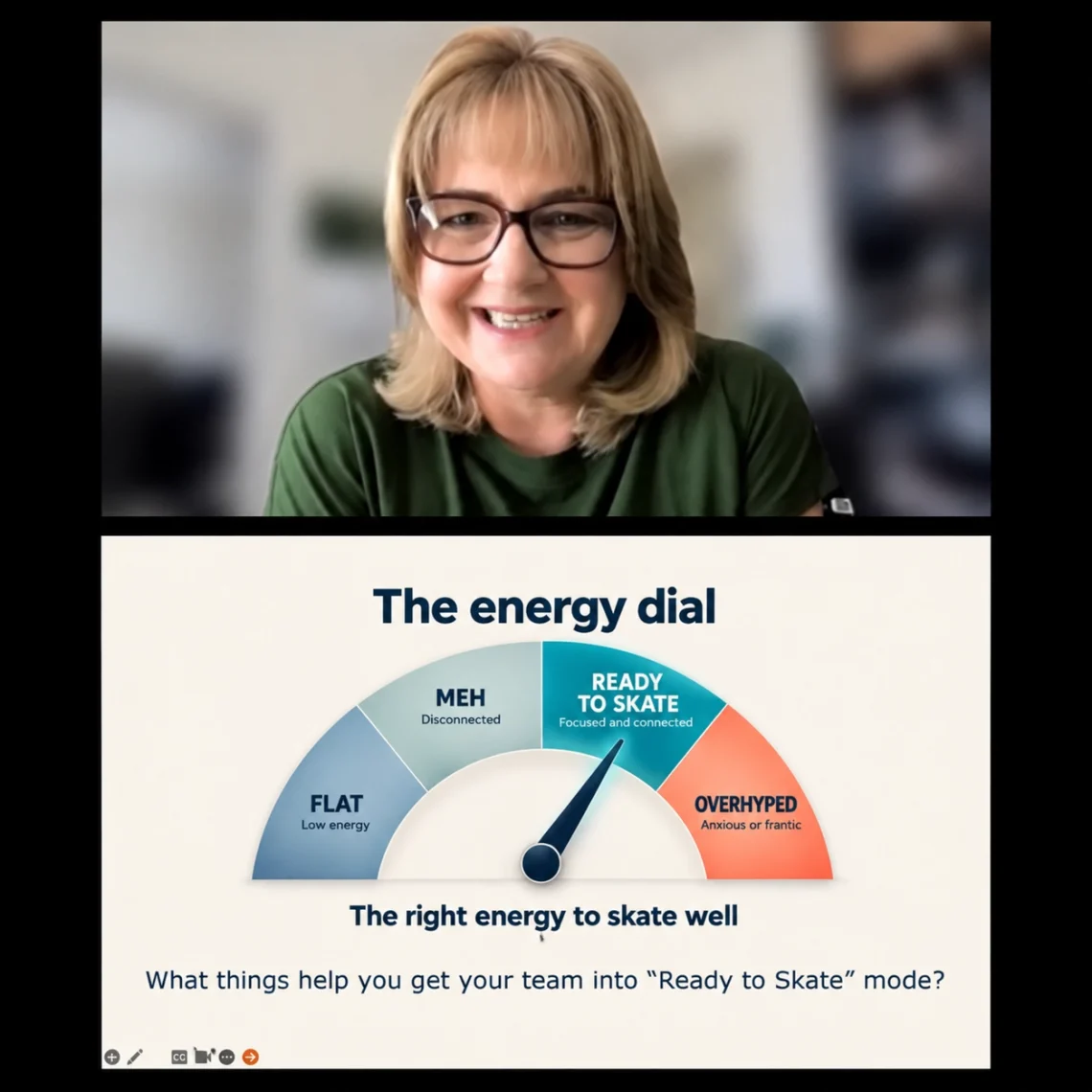
One of the questions I asked a group of synchronised skating captains recently was: “When your team is at its best, what strengths are showing up?”
Later, watching back the video I’d recorded for them, I realised I was answering that question for myself.
I could see my warmth, humour and enthusiasm. My love of helping people understand themselves and each other. My tendency to wander off into an example, a story or, apparently, a Chumbawamba song.
I could also see the experience behind what I was sharing. Years of learning, facilitating, coaching and thinking about how to make ideas useful.
My professional confidence had taken a knock recently. Watching this video gave me a chance to recognise something I’d temporarily lost sight of.
“There I am,” I thought. And it felt good.
When a difficult experience gets bigger than it deserves to beI know how quickly I can move from “That didn’t go well” to questioning myself much more broadly. Was I any good? Have I still got it? Am I bringing anything useful?
One difficult experience can start taking up an unreasonable amount of space. Meanwhile, all the other experiences, the contributions we’ve made, the relationships we’ve built and the skills we’ve developed, somehow get less airtime.
I spend quite a lot of my working life helping other people recognise their capabilities – and I’m bloody good at it! I ask them for examples. When have you handled something difficult? What did you bring to that situation? What might you draw on again?
Watching this video gave me an example of my own.
I could hear myself explaining ideas in language that made sense for these captains. I could see the care I’d taken to give them something practical. I was enjoying myself, and I knew why I was doing it.
That was useful evidence to sit alongside the experience that had dented my confidence.
A sport I love, and people I respect
I volunteer as a leadership coach with a state sporting organisation, working with synchronised skating captains.
It’s close to my heart. I get to give something back to a sport I love and contribute alongside coaches I respect enormously. They put so much into their teams, often voluntarily, while also holding down full-time jobs.
The captains have plenty going on, too. School, study, work, training and the responsibility of helping lead their teammates.
With Nationals approaching, I wanted to give them a few things to think about and discuss together. How is the team feeling? What helps them get ready to skate? How might they respond when something unexpected happens? What strengths can they draw on?
These are conversations I love having. There’s a very clear purpose to them, and a chance to turn an idea into something someone can actually use.
The advice I could hear myself giving
In the video, I encouraged the captains to prepare for curveballs.
A practice skate might go badly. A schedule could change. Someone might make a mistake. The team before them might skate brilliantly, leaving everyone feeling a little more nervous.
We talked about steadying yourself first, acknowledging what has happened and helping the team focus on what it can control.
Watching it back, I thought: yes, Ange. You might want to take some of your own advice.
I also asked them to think about their team’s strengths. What’s happening when they perform well together? What do they bring out in each other? What are their secret weapons?
Then, the practical part: how could they use those strengths deliberately?
If perseverance is a strength, perhaps it means helping each other refocus after a mistake. If curiosity is a strength, perhaps it helps them approach an unfamiliar challenge with a little more openness.
And somewhere in there, Chumbawamba made an appearance. I couldn’t resist a little singing about getting knocked down and getting back up again. (I’m fairly sure none of the captains had asked for a musical contribution. They got one anyway).
Playfulness is part of how I connect with people. So are stories, questions and examples. Watching myself use those things naturally reminded me how much I enjoy this work.
Letting ourselves feel proud
I felt proud of the video, and I wanted to let myself enjoy that feeling.
I’d put thought into it. I’d brought experience and care to it. I’d made something I believed could help.
It can feel surprisingly exposing to say, “I’m good at this.” Even privately, we can rush to qualify it or find something we should have done better.
There were certainly things I could have polished in the recording. I could have been more concise. I probably could have spared everyone the singing.
But I liked the person I saw. She knew her subject, cared about the people she was speaking to and wanted to help them lead well.
I want to be able to notice that about myself with the same generosity I’d bring to noticing it in someone else.
Paying attention to the joy
The other thing I noticed was how much I was enjoying myself.
I loved thinking about these teams and what might help them. I loved bringing together leadership, strengths and wellbeing in the context of a sport that matters to me.
That enjoyment is something I want to pay attention to as I think about my work and where I put my time and energy.
There are clues in the activities we look forward to, the conversations we keep thinking about afterwards and the moments when our experience comes together naturally. They can help us understand what we want to keep doing, develop further or make more room for.
This piece of volunteering gives me connection, contribution and a chance to use skills I’ve spent years building. It also gives me a lot of joy.
I’m grateful for that.
And I’m glad I watched the video back.
When have you recently thought, “There I am”? What were you doing, who were you with, and what might that tell you about the work you want more of?