
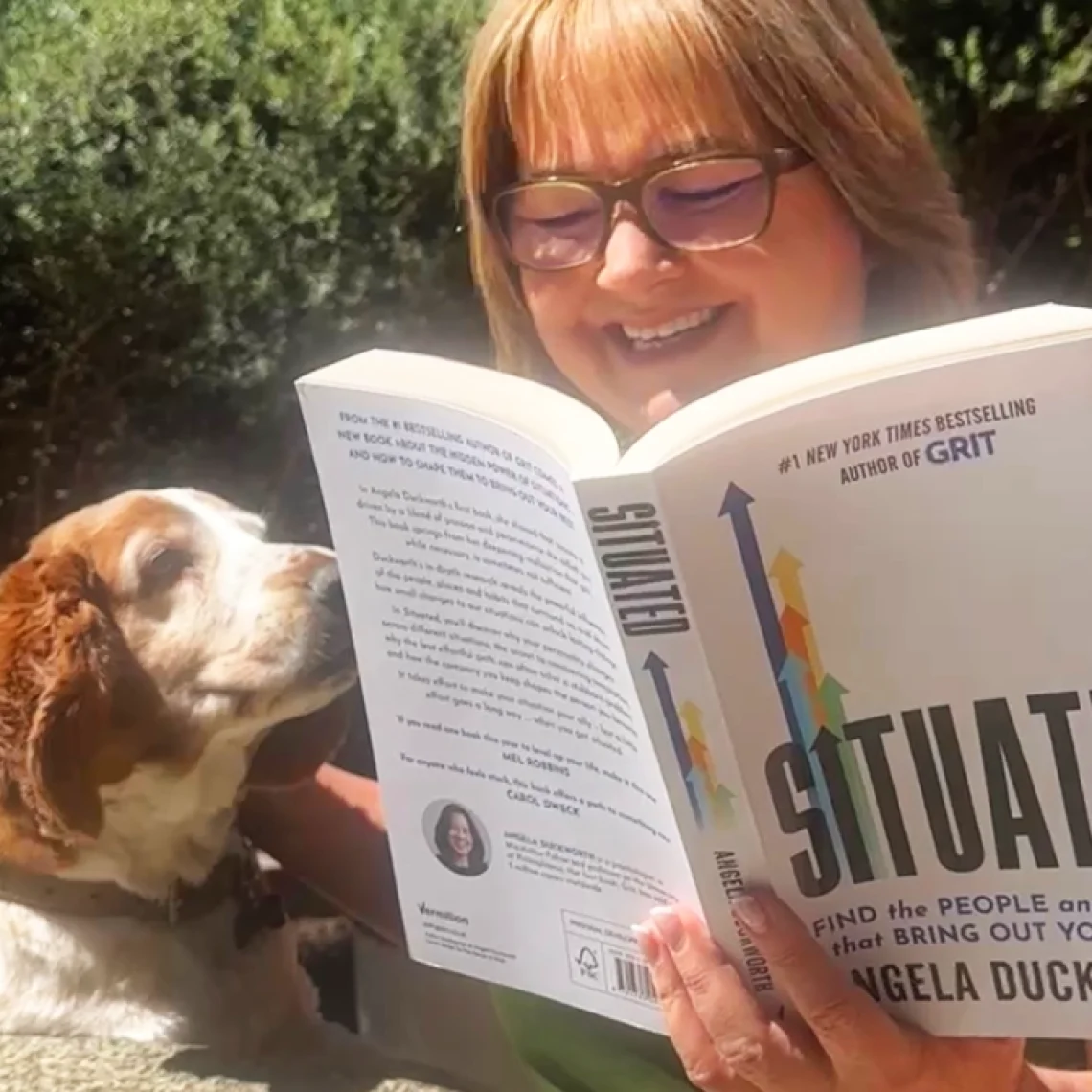
Some reflections on Angela Duckworth’s latest book, Situated
I’ve never been a huge fan of Grit. Angela Duckworth’s bestselling book about passion and perseverance never particularly resonated with me. Truthfully, it’s probably because I’ve never thought of myself as a particularly gritty person.
Interestingly, people close to me would disagree. They’ve pointed out that when something really matters to me, when it’s something I care deeply about or believe in, I can be extraordinarily persistent. But gritty isn’t how I tend to see myself. The word conjures up images of digging in, pushing harder and relying on sheer willpower to get things done. And, if I’m honest, some of the messaging around grit has occasionally left me feeling a little inadequate.
So I’ve found reading Angela Duckworth’s latest book, Situated, incredibly refreshing.
It’s given me plenty to think about and has made me feel hopeful about the direction that some of the thinking in positive psychology is taking.
It’s not just about the individual
The central idea of Situated is that who we become, how we behave and what we achieve aren’t simply down to our individual determination or willpower. The people we surround ourselves with, the places we live and go to, and the cultures we’re part of (whether we’ve chosen them or not) matter enormously. They influence everything from our health and wellbeing to our educational achievements, our habits and our opportunities in life.
For years, we’ve been telling people that if they really want something, they just need to work harder, persevere and believe in themselves. But what if we paid more attention to the situations people find themselves in? And what if, rather than simply expecting people to try harder, we worked to improve those situations?
There were several ideas in the book that particularly stayed with me.
Performance is individual, but success is collective
I love this observation from Nicolas Castel, a French swimming coach who worked with Olympic champion Léon Marchand. We often celebrate individual achievement without fully appreciating the people and circumstances that have helped make it possible.
Having spent many years as the parent of a competitive figure skater, I’ve seen firsthand just how much sits behind an athlete’s performance. Coaches, teammates, parents, friends, volunteers and an entire community can contribute to what we eventually see on the ice.
And it’s not just in sport.
Think about education. We celebrate exceptional academic results, but we don’t always see the layers of support behind them. The school environment, the teachers, the tutoring, the encouragement at home and the opportunities available.
Some young people have access to extraordinary levels of support, while others have very little. And sometimes that comes down to family income, where someone lives, or whether their parents can afford to move into the catchment area of a high-performing school.
This is something I find deeply troubling.
If the situations we’re in have such an enormous influence on our outcomes, then we need to think much more carefully about fairness and opportunity, rather than attributing success or failure entirely to individual effort.
Self-confidence is not self-generated
This was another idea I loved.
Confidence is something I talk about frequently in my work, particularly with the women I coach and the leadership programs I facilitate. We often speak about confidence as though it’s something we need to find within ourselves. And of course, our own beliefs and experiences matter.
But the belief that other people have in us can be extraordinarily powerful. Albert Bandura’s work on self-efficacy support this and recognises the role of encouragement and social persuasion in developing our belief in our capabilities.
I’ve also experienced this many times in my own life.
In my early twenties, I was desperate to move into public relations. I had an opportunity to meet with a senior woman working in communications, and we had a wonderful conversation. She told me she could see a younger version of herself in me and then she did something extraordinary: she gave me an opportunity to join her department in a junior role, learn from others and start building a career in communications.
Her belief in me helped me believe that I could do it. I went on to complete postgraduate studies in communications and build a career in an industry I loved.
Years later, something similar happened.
Diana Ryall AM (she/her), the founder of Xplore for Success, suggested that I would make an excellent coach and encouraged me to undertake coaching training. I’d never really imagined myself as a one-on-one coach and it wasn’t something I’d been planning to do, but Diana saw something in me that I hadn’t necessarily seen in myself.
Becoming a coach turned out to be one of the best professional decisions I ever made. Coaching is a part of my work that I absolutely love – and I also believe I am pretty good at!
When I look back over my career, some of the most significant opportunities I’ve had have come about because someone else saw potential in me and encouraged me to act on it.
Sometimes we need someone else to believe in us before we can fully believe in ourselves.
And I wonder how often we underestimate the difference we can make simply by telling someone what we see in them.
Growth needs both challenge and support
Another idea Duckworth explores is the relationship between challenge and support. High expectations without adequate support can lead to burnout. Lots of support without challenge can lead to complacency. But when people experience both high challenge and high support, we create the conditions for growth.
I’ve seen this in sporting environments, in workplaces, in coaching conversations and in my own life. When we’re doing something that stretches us, particularly something we really care about, having people around us who encourage us, challenge us and want us to succeed can make an enormous difference. It doesn’t mean the work becomes easy. It means we don’t have to do the hard work entirely on our own.
Believe in one another
And then, to my delight, Duckworth brings Ted Lasso into the conversation. (Anyone who knows me knows how much I love that television series!).
Ted’s famous BELIEVE sign in the changing room isn’t simply about believing in yourself. It’s about believing in one another.
I was reminded of this recently working with four synchronised skating teams preparing for their national championships. We spent time talking about team culture, the energy they wanted to bring onto the ice, and the strengths and qualities they appreciated in one another.
One of my favourite parts was giving the skaters an opportunity to tell their teammates what they valued about them. There’s something incredibly powerful about hearing someone else describe the contribution you make.
And it’s equally powerful to be the person who gives that encouragement.
From self-actualisation to self-transcendence
Towards the end of Situated, Duckworth explores Abraham Maslow’s later thinking.
Most of us are familiar with Maslow’s hierarchy of needs, usually represented as a pyramid with self-actualisation at the top. But, as Duckworth reminds us, Maslow never actually drew that famous pyramid. And in his later years, he increasingly emphasised something beyond self-actualisation: self-transcendence.
The idea that the highest expression of human potential isn’t simply about becoming the best version of ourselves, but about contributing to something beyond ourselves.
I found this particularly meaningful.
When I was studying positive psychology, one of the questions I kept coming back to was where the we and the usfitted into our understanding of flourishing. I’ve always believed that so much of the important stuff in life happens when we’re part of something bigger than ourselves.
Even something as ordinary as my gym routine illustrates this.
For nearly two years now, I’ve been going to the gym four or five times a week. If you’d told me a few years ago that I’d establish that habit, I might have laughed. But the reason I’ve kept going has relatively little to do with extraordinary discipline or willpower. It’s because I love the people I train with. I enjoy seeing them. I feel connected to them. And I feel a sense of commitment to showing up, not just for myself, but for the group.
The situation I’m in makes the behaviour easier.
So where does that leave me?
I’ve already started recommending Situated to a number of my coaching clients.
I appreciate that Duckworth hasn’t abandoned grit or the importance of individual effort. But I welcome the attention she’s giving to the relationships, environments and cultures that help us succeed. It feels like an important shift in emphasis.
And it reminds me that we don’t just need to think about the situations we’re in. We also have an opportunity, and perhaps a responsibility, to help create better situations for others.
In fact, just today I was exchanging messages with a friend. We’ve both signed up for a book-writing program and we’re both feeling a little nervous about it. There’s a fair bit of self-doubt and imposter syndrome floating around between us! But we both really want to write our books. So we’ve joined a community of people doing the same thing, and we’ve made a commitment to encourage and support one another along the way. I have no doubt there will be moments when we need to dig deep and persevere. But I also know that being part of a community, and having someone alongside me who understands the excitement and uncertainty of what we’re trying to do, will make a difference.
And that’s probably my biggest takeaway from Situated. We spend so much time asking ourselves, “How can I be better?” I’d love us to spend more time asking, “How can we help each other be better?”
Because we don’t become our best selves on our own.
A note on AI: The ideas, reflections and personal experiences in this article are my own. I used AI to help organise my dictated notes and develop them into a structured article, which I then reviewed and edited multiple times.